Becoming a Subject Matter Expert: Filming Marva Labs and the Fight Against Antimicrobial Resistance
Most brand films are about a product you can hold. Some are about a problem you have to understand first. Our shoot with Marva Labs was the second kind.
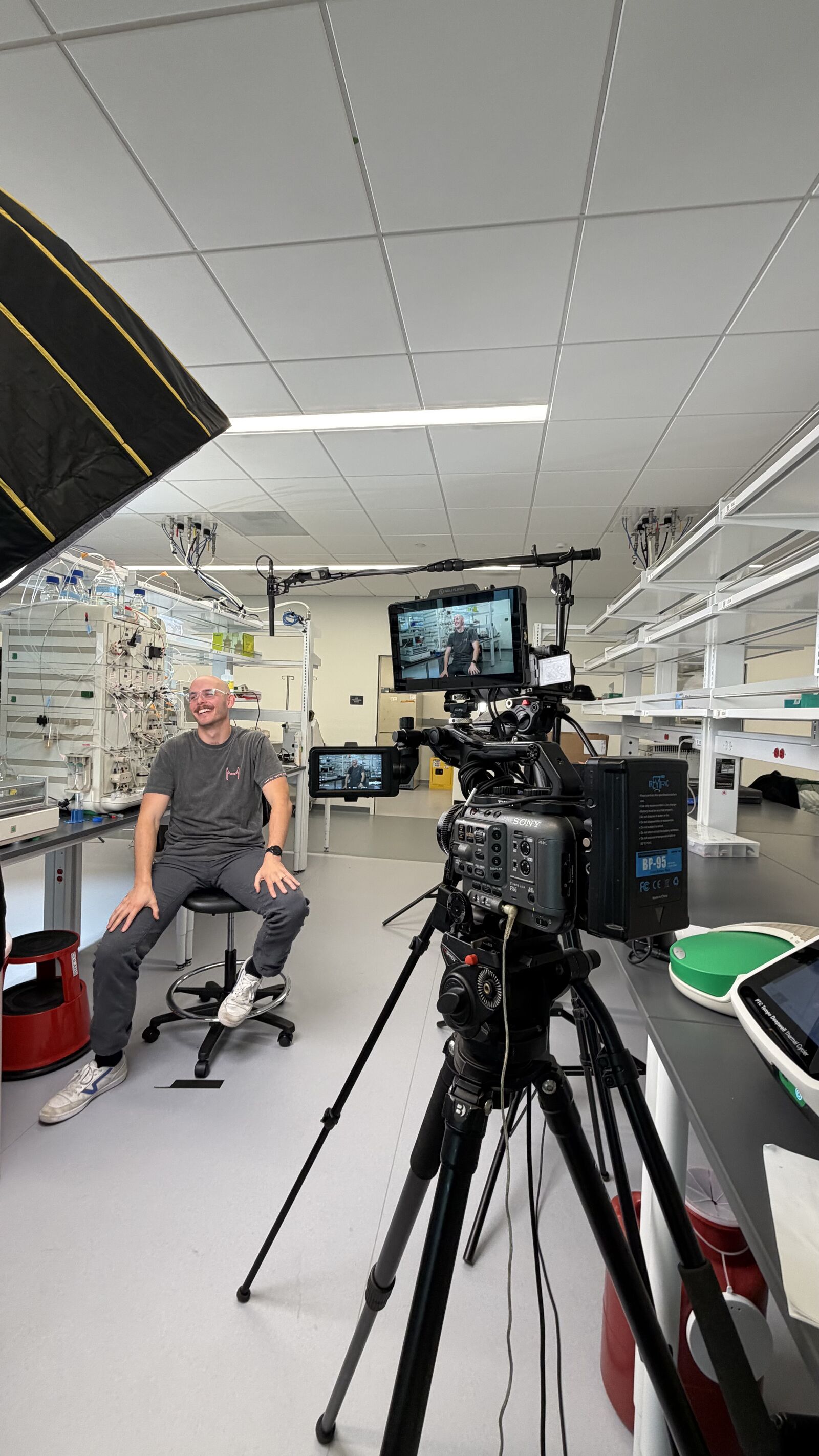
We filmed at CoLabs in Seattle, a shared lab and research space at 222 Fifth. Working inside a real working lab meant the environment did half the storytelling for us: glassware, benches, people actually running experiments in the background. It also meant tight quarters and careful lighting, which is a trade we will take every time over a staged set.
Marva Labs is working on antimicrobial resistance, one of the quieter global health threats of our lifetime. Bacteria evolve past the drugs we use to kill them, common infections stop responding to treatment, and routine procedures get dangerous again. That is a hard thing to explain in ninety seconds to an audience that has never heard the term. It is an impossible thing to explain if the director does not understand it either.
Why the director has to learn the subject
There is a version of this job where you show up, light the room, ask "tell me about your company," and let the edit sort it out. It produces footage. It does not produce a story.
The problem is that a scientist answering a vague question will answer it the way they would answer a colleague. You get jargon, you get accuracy, you get nothing an outside viewer can hold onto. The interview is only as good as the question, and a good question requires knowing enough about the work to ask about the thing that actually matters.
So before this shoot, I did homework. Not enough to be a microbiologist. Enough to know what resistance mechanisms are, why the antibiotic pipeline has thinned out over decades, where the economics broke, and what Marva Labs is doing differently. Enough to hear an answer and know whether it was the real one.
Building the question list
The question list is the shot list for an interview. I built this one in layers.
1. Stakes questions
These establish why anyone should care, in human terms. Not "what is antimicrobial resistance," but "what does a hospital look like when the antibiotics stop working?" The first version gets a definition. The second gets a story.
2. Origin questions
Why this team, why this problem, why now. Founders answer these well because they have lived them, and the answers carry conviction that no amount of B-roll can fake.
3. Mechanism questions
The science, asked in a way that invites an analogy. I explicitly asked for comparisons: "if you were explaining this to your neighbor, what would you compare it to?" Some of the strongest lines in the edit came out of that framing.
4. Contrast questions
What everyone else has tried, and why it has not worked. Contrast is how an audience understands value. Without it, every biotech sounds identical.
5. Future questions
Where this goes if it works. These give the film its ending and give investors, partners, and recruits something to attach themselves to.
6. The throwaway that is not a throwaway
Near the end, once the camera has been rolling long enough that people forget it is there: "what keeps you working on this?" That question has ended more of our films than any scripted line ever has.
What preparation does on set
Practically, the research bought us three things.
Follow-ups. When a scientist said something that mattered and moved past it, I could stop and ask them to go back. You cannot recognize the important sentence if you do not understand the topic.
Trust. Technical people relax when they can tell you have done the reading. The interviews got looser and more human within a few minutes because nobody was translating down to me.
Better B-roll. Knowing the process meant knowing what to film in the lab. Not just "beakers and blue light," but the specific steps that illustrate the specific claims being made in the interviews. The visuals support the argument instead of decorating it.
The lesson for any technical brand film
If your business is complicated, hire a crew that will learn it. Ask what your production company plans to read before the shoot. Ask to see the interview questions in advance. A shooter who arrives with generic questions will leave with generic footage, and no editor can rescue that.
The Marva Labs shoot worked because the questions were built for Marva Labs. That is the whole trick, and it happens days before anyone touches a camera.
Working on something complicated?
Peak Visuals produces brand films, founder stories, and technical explainers for science, healthcare, and enterprise teams across Spokane and the Inland Northwest. We do the reading. Get in touch and tell us what you are building.
Ready to create video that drives results?
Book a free strategy call and let's talk about your next project.
Book a Free Call